





BEAUTY
Best Hair Straightener for Thick Hair: What Actually Works?
By Zeven Miller
Updated 7 PM EST Oct 11, 2026
Thick hair can make a bad straightener feel almost useless. You smooth one section, move to the next, and realize the first piece is already puffing back up. Or you need four passes to straighten a section that should have taken one.
If that sounds familiar, the problem may not be your technique. Thick hair usually needs steady heat, reliable contact and enough control to smooth each section without repeatedly going over it. The right flat iron for thick hair should make the routine more efficient, not simply make the plates hotter.
The best choice also depends on the finish you want. A traditional flat iron generally creates the sleekest result. A straightening brush leaves more natural body, while a hybrid tool sits somewhere between the two.
Here is the short answer:
- Choose a flat iron for maximum sleekness and precision.
- Choose a straightening brush for easier smoothing with more volume.
- Choose a comb-and-iron hybrid when you want guided tension and more styling flexibility.
- Whatever you choose, look for adjustable heat and use the lowest effective temperature for your hair.

The Best TYMO Straighteners for Thick Hair at a Glance
There is no single straightener that is best for every person with thick hair. Someone with dense, wavy hair who wants a polished finish needs something different from someone with thick, coily hair who wants to preserve volume.
This quick comparison should make the choice easier.
| Our pick | Best for | Styling result | Temperature range |
|---|---|---|---|
| TYMO FLAIGHT HOLO PREMIUM | A sleek, polished finish | Smooth, straight hair with precise control | 265°F to 430°F |
| TYMO RING PLUS | Thick, curly or coily hair that benefits from brush-through styling | Smooth hair with more natural body | 250°F to 410°F |
| TYMO FLIPRO | Guided styling with a comb-and-iron design | Straight, smooth hair with flexible shaping | 265°F to 410°F |
These are TYMO recommendations, not a claim that one brand or product works for everybody. Start with your hair texture, its current condition and the finish you actually want.
You can also compare the full range of TYMO hair straighteners.

What Does Thick Hair Actually Need From a Straightener?
“Thick hair” can describe several different things.
You may have a lot of individual strands, which is high density. Your strands may be coarse in diameter. Your hair may also be curly, coily, frizzy, color-treated or damaged.
That distinction matters. Dense but fine hair should not automatically be treated like coarse, resistant hair just because there is a lot of it.
Here is what generally matters most.
Adjustable Temperature
A fixed high temperature gives you very little control. Thick, healthy, coarse hair may require more heat than fine or fragile hair, but that does not mean you should start at the highest setting.
Look for a tool with multiple temperature options so you can start lower and increase only when necessary.
Consistent Contact
Heat alone does not straighten hair. The tool also needs to maintain contact and tension as it moves through the section.
If the plates do not grip evenly, or if a brush cannot reach through the section, you may end up passing over the same hair several times.
A Smooth Glide
A straightener should move through the hair without catching or pulling. Snagging slows down the routine and creates unnecessary stress on the strands.
Always detangle before styling rather than expecting a heated tool to force its way through knots.
Enough Coverage for Your Hair Length
Wider plates can help cover more hair on long, dense sections, but bigger is not always better. A narrower tool offers more precision around the roots, short layers, bangs and ends.
The right size depends on both your hair density and how you plan to style it.
A Design You Can Control
Thick hair can take time to style. Weight, grip, cord movement and button placement matter more after you have been holding the tool for 20 minutes.
A technically powerful straightener is not useful if it feels awkward halfway through your routine.
Flat Iron or Straightening Brush: Which Is Better for Thick Hair?
Both can work well. The better option depends less on whether your hair is “thick” and more on how straight you want it to look.
| Choose a flat iron if you want | Choose a straightening brush if you want |
|---|---|
| Maximum straightness | Smoothness with natural volume |
| Precise control over individual sections | A familiar brush-through motion |
| Sleek roots and polished ends | More body through the roots |
| Greater compression on resistant areas | Easier coverage through dense hair |
A flat iron presses the hair between two heated plates, which gives you more compression and control. This usually makes it the stronger option for a pin-straight or highly polished result.
A straightening brush separates and smooths the strands as you brush. It can get thick hair very straight, but the result often looks fuller and less compressed.
If you are still unsure, read our full comparison of a straightening brush versus a flat iron.

Best TYMO Hair Straighteners for Thick Hair
Best for a Sleek Finish: TYMO FLAIGHT HOLO PREMIUM
The TYMO FLAIGHT HOLO PREMIUM is the best fit here when maximum smoothness and a polished finish are the priorities.
It has ten temperature settings from 265°F to 430°F, giving you room to adjust the heat instead of styling every section at the same temperature. Its heated plates use a NanoFiber protective cover, while the rounded body can also be used for flipped ends, bends and curls.
This tool makes the most sense if:
- You want a sleek, flat-ironed finish.
- Your hair is thick, wavy, curly or frizz-prone.
- You want more precision around the roots and ends.
- You prefer a traditional plate tool.
- You want to create straight styles as well as curls or bends.
It may be less convenient if your hair is extremely dense and you prefer a fast brush-through routine. In that case, a straightening brush may feel easier to work through the full head.

TYMO FLAIGHT HOLO PREMIUM
- Best For: Sleek, polished results
- Hair Types: Thick, wavy, curly and frizz-prone hair
- Heat Settings: 10 settings, 265°F to 430°F
- Finish: Smooth and precise
Best Straightening Brush for Thick Curly Hair: TYMO RING PLUS
If you want straight hair without pressing out every bit of movement, the TYMO RING PLUS is the stronger brush-based option.
Its heated teeth help separate and organize dense hair as the brush moves through each section. It offers nine settings from 250°F to 410°F, plus an anti-scald shell and nano titanium coating.
RING PLUS is particularly useful when:
- Your hair is thick, curly, coily or difficult to organize into flat sections.
- You want a smooth finish that still has body.
- You find a brush motion easier than clamping individual sections.
- You want to work closer to the roots without flattening them completely.
- You prefer several temperature choices.
A straightening brush does not apply the same compression as a flat iron. If your goal is a very flat, glass-like finish, you may still prefer FLAIGHT HOLO PREMIUM.
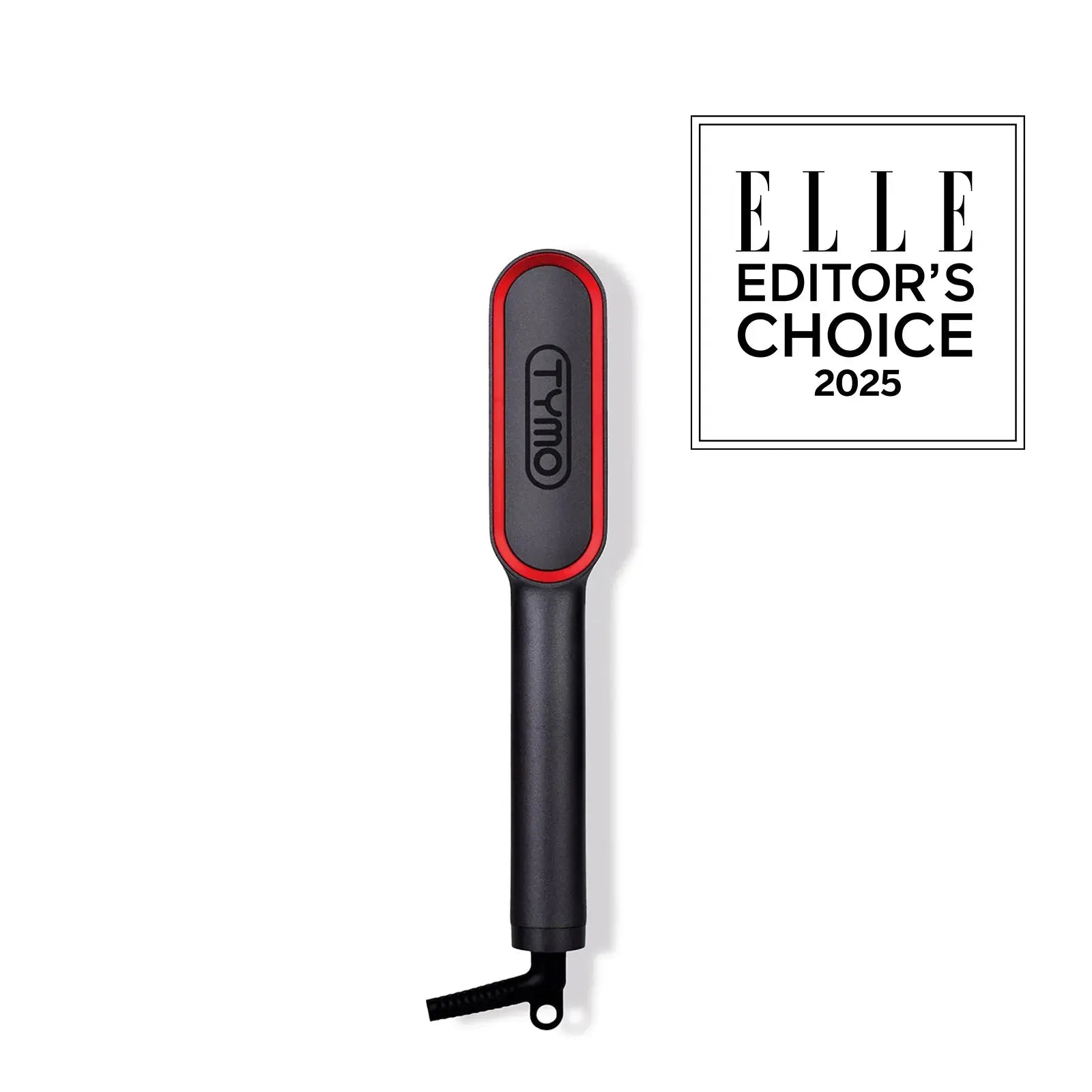
TYMO RING PLUS
- Best For: Thick, curly and coily hair
- Hair Types: 1A to 4C
- Heat Settings: 9 settings, 250°F to 410°F
- Finish: Smooth with natural volume
Best Hybrid for Guided Control: TYMO FLIPRO
The TYMO FLIPRO combines a heated comb with a flat-iron-style design. It is a useful middle ground if you want the organization of a comb with more direct smoothing control.
Its design helps guide the hair into place before the heated surfaces smooth the section. FLIPRO offers five settings from 265°F to 410°F, dual PTC heating, wider plates and an anti-scald comb structure.
Choose FLIPRO if:
- You struggle to hold a separate comb and flat iron at the same time.
- You want help keeping thick sections aligned.
- Your hair is thick, coarse, curly or frizz-prone.
- You want to straighten, curve the ends or create loose movement.
- You want a hybrid rather than a conventional brush or flat iron.
The comb-and-iron motion can take a little practice. Start with small sections until you understand how much hair the tool can comfortably control.

TYMO FLIPRO
- Best For: Guided comb-and-iron styling
- Hair Types: Thick, coarse, curly and frizz-prone hair
- Heat Settings: 5 settings, 265°F to 410°F
- Finish: Smooth with flexible shaping
How to Choose a Straightener for Your Type of Thick Hair
Hair density is only one part of the decision. Use your texture and hair condition to narrow the choice.
Thick, Straight or Wavy Hair
If your hair is already relatively straight but tends to look puffy, focus on smooth contact and adjustable heat rather than the highest possible temperature.
A flat iron works well for a polished finish. A straightening brush is a good alternative when you mainly want to smooth the surface and reduce bulk without making the hair look flat.
Thick, Curly Hair
Curly hair needs tension as well as heat. Choose a tool that can maintain consistent contact without snagging.
A flat iron offers more compression for a sleek result. A straightening brush may be easier when you want to stretch and smooth the curl pattern while keeping some body.
Thick, Coarse or Coily Hair
Work in smaller sections and look for consistent, adjustable heat. Do not assume the largest section the tool can physically hold is the section it can straighten effectively.
RING PLUS can help separate and control dense hair, while FLAIGHT HOLO PREMIUM provides the additional compression needed for a more polished finish.
Thick, Frizz-Prone Hair
Frizz does not always mean the tool needs to be hotter. It may mean the section is too large, the hair was not fully detangled or the straightener is moving too quickly.
Use steady tension, finish one section before moving on and avoid repeatedly touching the hair while it is still warm.
Thick, Color-Treated or Damaged Hair
Hair can be thick and fragile at the same time.
Begin at a lower temperature, pay attention to how the hair responds and increase the heat only when needed. Concentrate on controlled passes rather than trying to overpower the hair with the maximum setting.

Is Ceramic or Titanium Better for Thick Hair?
Titanium and ceramic tools can both work on thick hair. Neither material is automatically best for everyone.
Titanium typically heats quickly and maintains strong, consistent heat, which can suit coarse or resistant textures. Ceramic is often chosen for more even, measured heat distribution.
However, the material is only one part of the design. Temperature control, plate contact, section size and technique all affect the result.
If your hair is thick but bleached, damaged or naturally dry, do not choose a tool based only on which material can become hottest.
For a deeper comparison, read our guide to titanium versus ceramic flat irons.
What Temperature Should You Use on Thick Hair?
There is no single correct flat-iron temperature for all thick hair.
Thick, coarse and healthy hair may need a higher setting than thick hair with fine individual strands. Color-treated, bleached or damaged areas may need less heat than healthier sections on the same head.
A safer approach is to:
- Begin below the tool’s maximum setting.
- Test a small section.
- Increase gradually only if the tool cannot smooth the section with a controlled pass.
- Reduce the heat around fragile areas, especially the hairline and ends.
- Stop repeatedly heating a section once it is already straight.
The American Academy of Dermatology recommends using flat irons on dry hair and choosing low or medium heat when possible. The goal is the lowest temperature that gives you the result you want, not the hottest temperature your hair can survive.
How to Straighten Thick Hair With Fewer Passes
The right straightener helps, but preparation determines how hard the tool needs to work.
1. Start With Completely Dry Hair
Unless your tool is specifically designed and labeled for wet-to-dry use, do not use it on damp hair.
Dry each layer completely, including the roots and the sections underneath. Hair that feels dry on the surface may still hold moisture inside a dense section.
2. Detangle Before Adding Heat
Remove knots with a detangling brush or comb. A heated tool should smooth an organized section, not act as a detangler.
3. Apply Heat Protectant Evenly
Use a lightweight protectant without saturating the hair. TYMO MIST Heat Protectant Spray is formulated to provide thermal protection up to 450°F and can be applied as part of your styling preparation.
4. Divide Your Hair Into Layers
Clip away the upper layers and begin underneath. Thick hair usually needs more sections than you think.
The section should be small enough for the heated surface to make consistent contact with all the hair inside it.
5. Use a Controlled Pass
Move slowly enough for the tool to smooth the section, but do not stop and hold it in one place.
One measured pass may be more efficient than several quick passes that never fully straighten the hair.
6. Let the Hair Cool
Warm hair is still settling into its new shape. Let each section cool before brushing through it, tying it back or applying a heavy finishing product.

Common Mistakes When Straightening Thick Hair
Taking Sections That Are Too Large
A large section may look smooth on the outside while the hair in the middle receives very little tension or heat.
If you keep returning to the same section, make it smaller.
Starting at the Highest Temperature
Maximum heat is a tool setting, not a styling goal.
Start lower and increase only when the hair genuinely needs it.
Making Several Fast Passes
Moving quickly may feel safer, but it does not help if you need to repeat the pass four or five times.
Use a controlled speed and consistent tension.
Straightening Damp Hair
Using a standard flat iron or heated straightening brush on damp hair can expose the strand to unnecessary stress. Dry the hair completely unless the tool is specifically designed for wet-to-dry use.
Skipping Heat Protectant
Thick hair is not immune to heat damage. Apply heat protectant before styling and distribute it evenly.
Expecting the Tool to Detangle
Pulling a hot tool through knots can create snagging and breakage. Detangle first.
Treating Every Part of Your Hair the Same
The roots may be denser, the hairline may be finer and the ends may be older or more damaged. Adjust the section size and temperature when necessary.
Applying Heavy Products Before Straightening
Too much oil or styling cream can weigh the hair down and leave buildup on the heated surface. Keep the preparation lightweight, then add finishing product sparingly after the hair has cooled.
Frequently Asked Questions
What type of hair straightener is best for thick hair?
A flat iron is usually best when you want maximum sleekness and precise control. A straightening brush may be better when you want easier smoothing with more natural volume. Look for adjustable temperature settings, consistent contact and a design you can comfortably control.
What is the best hair straightener for thick, frizzy hair?
Choose based on your desired finish. FLAIGHT HOLO PREMIUM is the stronger TYMO option for a sleek, polished result. RING PLUS is better suited to smoothing thick, frizzy hair while keeping more body.
What is the best hair straightener for thick, curly hair?
A flat iron works well for maximum straightness, while a strong straightening brush can be easier for stretching and smoothing dense curls. RING PLUS offers brush-through styling, while FLAIGHT HOLO PREMIUM provides more plate compression.
Is titanium or ceramic better for thick hair?
Titanium can suit coarse or resistant hair because it heats quickly and maintains consistent heat. Ceramic is often preferred for even, controlled heating. Your hair condition, the tool’s temperature controls and your technique matter as much as the plate material.
Is a straightening brush good for thick hair?
Yes. A straightening brush can smooth thick hair efficiently while preserving more volume than a flat iron. Work in sections small enough for the heated teeth to reach through the hair.
Are wider plates better for thick hair?
Wider plates can cover more hair and may be helpful for long, dense sections. Narrower plates provide more control around the roots, short layers and ends. Plate width should match both your hair density and your styling preferences.


